Sponsor this page for $75 per year. Your banner or text ad can fill the space above. Click here to Sponsorthe page and how to reserve your ad.
LONDON, ENGLAND 1851
The Great Exhibition of the Arts & Industries of All Nations
Quick List Info
Dates Open - May 1 to October 11, 1851. No Sunday
openings. Was also open Monday and Tuesday, October 13-14 to
exhibitors with the Closing Ceremony on October 15.
Attendance - Total paid and season ticket admissions,
6,039,195.
International Participants - 50 nations and 39 colonies/protectorates.
Total Cost - 335,742 pounds ($1,678,710)
Site Acreage - Entire site within Hyde Park covered 26
acres. The Great Exhibition building sat on 19 acres within the entire site.
Sanction - Prior to the Bureau of International
Exhibitions. Although often called a Universal Exhibition due to its broad scope, it would not be considered a Universal style exhibition in the 21st century due to its size. The exhibition was organized by a Royal Commission with Prince Albert playing a central role. The government supported the idea in principal, but not financially.
Ticket Cost - Adult admission prices ranged from 1
shilling (25 cents) to 5 shillings ($1.25) to 2 shillings and 6d (63 cents) to 1 pound ($5.00), depending on the
day. The average daily price was 59 cents.
For
more info about the World's Fair Decision Model, development of the model, the study participants, etc. The development is currently being utilized for in-house publishing projects, but is not available for work-for-hire decuments or consulting.
Exhibitions were part of the landscape in continential Europe as well as the English isles from the beginning of the late 1800s with the Society of Art hosting annual exhibitions from 1845 forward. When the idea of hosting the next in the series of national exhibition for 1851 was brought forward, the idea of turning it into an international event was broached.
This idea was not a new one, as other events had both solicited foreign contributions, i.e. Birmingham 1849, only to receive none, and the French national exhibition in the same year desired to be international, but the idea did not go over well with French manufacturers who did not want to compete against foreign products. On June 30, 1849, Prince Albert met with several colleagues, including Henry Cole, who had recently visited the Paris national exhibition and their idea, although turned down, of making in an international event. Prince Albert concurred and the committee agreed on six goals.
1) ... that the exhibit would have four divisions, (raw materials, machinery, manufactured products, and sculpture and plastic art generally.)
2) ... that it would be held in a temporary building in Hyde Park.
3) ...that the scope would be International.
4) ...that substantial prizes should be offered.
5) ...that a Royal Commission, with Prince Albert at its head,
should carry out the plans.
6) ... and that funds would be raised by voluntary subscriptions and collected by the Royal Society of Arts.
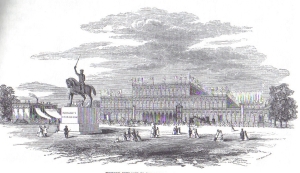
On January 3, 1850, a Royal Commission was granted charter by the Government, taking over responsibilily from the Society of Arts. A subscription fund was launched on January 25, with the first list headed by the Queen and Prince Albert. By end of February, 70,000 pounds were subscripted, but more donations came in slowly. After that hesitant beginning, the guarantee fund rose to 350,000 pounds. The site problem was overcome by the approval of Hyde Park. And Joseph Paxton solved a third problem, of a temporary building of sufficient scope, by proposing the glass and iron Crystal Palace, which required only 17 weeks to erect building.
Inside the huge nineteen acre construction, half of the gallery exhibit space was taken by British goods and the remaining space, foreign. More than 40 different countries and their possessions were represented, including France, the most prominent.
The opening ceremonies were held on May 1 with Queen Victoria and her husband, Prince Albert, present and pleased. Attendance of over 6 million traipsed past the exhibits during the fair, and after the even was completed, a surplus of 200,000 pounds remained as profit. The surplus was used to acquire land in South Kensington, adjacent to the site. Subsequent years saw the granting of help to the foundations of educations institutions to build on that land and establish a system of scholarships, some of which last until this day.
The Crystal Palace itself was rebuilt in a larger version at Sydenham, and used as centre of popular entertainment, instruction, and cultural activities until it was destroyed by a fire in 1936.
Source: The Story of Exhibitions
International Participants
Nations
Austria, Belgium, Bolivia, Brazil, Chile, China, Denmark, Egypt, France, Great Britain, States of Zollervein (Germany not established until 1870, individual kingdoms/states were listed:
... Anhalt, Bavaria, Baden, Bremen, Brunswick, Hesse, Hesse-Darmstadt, Nassau, Prussia, Saxony, Saxe-Meiningen , Frankfurt, Hamburg, Hanover, Lubeck, Oldenburg, Mecklenburg-Strelitz, Mecklenburg-Schwerin, Nuremburg, Thuringia, Wurtemburg...),
Greece, Haiti, Holland, Mexico, New Granada (Columbia), Persia
Portugal, Italy (Italy not established until 1861,
individual kingdoms/states lited until then: ... Rome, Sardinia, Tuscany, Naples ...), Russia, Spain, Sweden & Norway, Switzerland, Tunis, Turkey, United States of America.
Colonies/Protectorates
Algiers, Society Island, East Indies, Indian Archipelago, Jersey
Guernsey, Ceylon, Ionian Islands, Malta, Cape of Good Hope, Natal, West Coast of Africa, Canada, Nova Scotia, Newfoundland,
New Brunswick, St. Helena, Mauritius, Ile Maurice, Seychelles,
St. Domingo, Grenada, Montserrat, St. Kitt's, Barbados, Antigua,
British Guiana, Bahamas, Trinidad, the Bermudas, South Australia, Western Australia, New Zealand, New South Wales, Van Diemen's Land, Labuan and Borneo, Hong Kong, Jamaica, Madere.
Historian's Perspective
Thomas Prasch - "The London sequence features a steady decline in interest and level of national profile after the stellar debut of the Crystal Palace in 1851. It is worth noting that the designers of the exhibition (Henry Cole and his circle most centrally) did not intend a triumphant display of national pride even in 1851, but rather sought to highlight the weaknesses of English production, especially in regard to design. The notion of the Crystal Palace as a great triumph of English supremacy, therefore, does not fit their own intentions. ... concerns before opening over crowd control, especially the behavior of working-class visitors. This changed almost immediately after opening. For 1851, practically the only significant voice of dissent was John Ruskin, but it's a great dismissal: he compared the Crystal Palace to a "giant cucumber frame."
"Well, it's the first world's fair, that counts for a lot. Also significant displays of new technology, most of it industrial but also photography. The building itself becomes a prototype for glass-and-steel buildings for the rest of the century. The themes for the S. Kensington fair all involve the developing program of Cole and his circle for a reinvigoration of English design and a bridge between arts and technology. This was served the the development of the major museums at S. Kensington (Victoria & Albert, museums of science, naturual history, etc.) Over the course of the quarter century after 1851. So the themes are designed very much for the English industrial context and fit very well. In the London sequence, the funding for the first fair was by subscription and generally fairly secure, although cost overruns presented some problems in the rush toward completion. The profits of 1851 in turn finance later fairs."
First World's Fair in History
Season Tickets
Price: 3 pounds 3 shillings for men ($15.75),
2 pounds 2 shillings for women ($10.50)
Number of Season Tickets Sold: 25,605 and used 773,766 times,
for average use of 30.22.
Expo Tidbits
What musical instrument did Antoine Sax introduce at the London fair of 1851?
False teeth, chewing tobacco, and rubber (vulcanized) boots were introducted by Charles Goodyear.
The first International yacht race was held.
The term "Crystal Palace" was first applied by "Punch" in an issue sold 11-2-1850.
Panes of glass used: 293,655.
Iron used: 4500 tons.
The interior color scheme: (red, light blue, white).
There were hanging banners for each country and class of material in red with white lettering & borders.
The exterior was white or stone color, picked out in blue.
Total amount of exhibit space - 991,857 square feet.
Largest attendance - October 7 - 109,915 with 93,224 in the Crystal Palace at one time on the same day.
April 1 to September 30, 1851. 4,237,240 people arrived in London, 50% more than in same period of the previous year.
Nothing but refreshment sold inside the Crystal Palace with Messrs. Schweppes held catering concession.
Legacies
Colebrookdale Gates (in north transept) which divides Kensington Gardens from Hyde Park.
Exhibition Road.
Paxton's Head public house Knightsbridge.
Prince Albert's model dwellings in Kennington.
The Memorial to the exhibition behind Albert Hall.
Mosaic in the quadrangle of Victoria and Albert Museum.
The Catalogue of the exhibition in the Prince Consort's right hand in statue on Albert Memorial.
87 acres of land in South Kensington bought with the surplus where now stands Victoria and Albert Hall, the Science Museum, the Natural History Museum, the Geological Museum, the Imperial College of Science & Technology, the Royal College of Art, and the Royal College of Music.
Other London commercial exhibits and government attractions around London had a banner year in 1851 due to the opening of the Crystal Palace.
Windsor Castle drew 31,228 in 1850, 129,400 in 1851.
British Museum 720,643 in 1850, 2,230,242 in 1851.
Tower of London-Armory 32,313-1850, 233,561-1851.
Tower of London Crown Jewels 32,888 to 209,000-1851.
Reports from the Participants "Greece"
The Great Exhibition of 1851 - the mental Olympic games
of the united world!
GREECE. 25 Finsbury Circus, London, February 27, 1852
GENTLEMEN - As the labours of the Greek Committee in connexion with the Great Exhibition of 1851 are now terminated, the Committee desire me, before separating, to express to
His Royal Highness Prince Albert, and the Royal Commissioners, their most grateful thanks for the unceasing support and valuable facilities invariably afforded them upon every occasion, during the tenure of their office, in their efforts to carry into effect the part assigned them in those gloriously conceived and newly revived Olympic games, in which not the physical, but the mental powers of the united world have been called into friendly competition, in order to augment and advance the sources of happiness, and the well-being of mankind.
The Committee feel it a pleasurable duty to request the Royal Commissioners to convey to the indefatigable Captain Owen their especial acknowledgments for his constant urbanity, valuable advice and assistance, upon all occasions when referred to; which not only lightened their exertions, but proved most advantageous, by enabling them to complete their arrangements in an efficient manner. I have the honour to be, with the highest respect and consideration,
GENTLEMEN,
Your most obedient, most humble Servant, (In the absence of the President of the Greek Committee,)
P. RALLI
(Signed) D.P.SCARAMANGA
The Secretary. The Royal Commissioners of the Great Exhibition of 1851
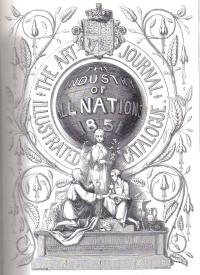
Source: OFFICIAL DESCRIPTION AND ILLUSTRATED CATALOGUE
OF THE GREAT EXHIBTION 1851, published by Spicer Brothers,
December 1852
Much thanks to John Greatrex at the Crystal Palace Foundation
for pointing out this report.
Those in Charge
The Royal Commission included...
Lord John Russell, then Prime Minister,
Sir Robert Peel, Lord Stanley, W.E. Gladstone, Lord Granville, Vice President of Government. Henry Labouche're, Charles Barry, architect, Robert Stephenson and William Cubitt, engineers,
Sir Charles Eastlake, President of the Royal Academy, and
Sir Charles Lyell, geologist.
Detailed work continued in hands of the Trustees, Treasurers, and an Executive Committee formed from the Society of Arts. Scott Russell and Sir Stafford Northcote were the two joint secretaries with Henry Cole on Executive Committee.
History of America
Check out our partners at America's Best History for the
history of the United States. Great for students of history or just those that want to find out a little more about the whats, when, wheres, and how of heritage tourism.
Stat Geek Baseball, the Best Ever Book. Some of the most
unique info on the Best Ever in baseball you'll get anywhere! The Best Yankee! The Best Red Sox! The Best of Every Team!
Fields of Gold, Baseball's Best Glove Work
The newest book in the Stat Geek Baseball universe.
Fields of Gold, Baseball's Best Glove Work. It's what the Best Ever Book was for hitting and pitching, but now a detailed look at the Best Fielders in Baseball History, including best position players for every team, and best overall for every position